.jpg)
Also known as ‘the fish scale’ condition, Ichthyosis vulgaris is more than just dry skin...
“Ichthyosis vulgaris is one of those conditions that's often mistaken for someone just having ‘really dry skin,’” explains Dr Kemi Fabusiwa, AKA Dr Fab, the viral 'docfluencer' who educates about skin conditions on social media.
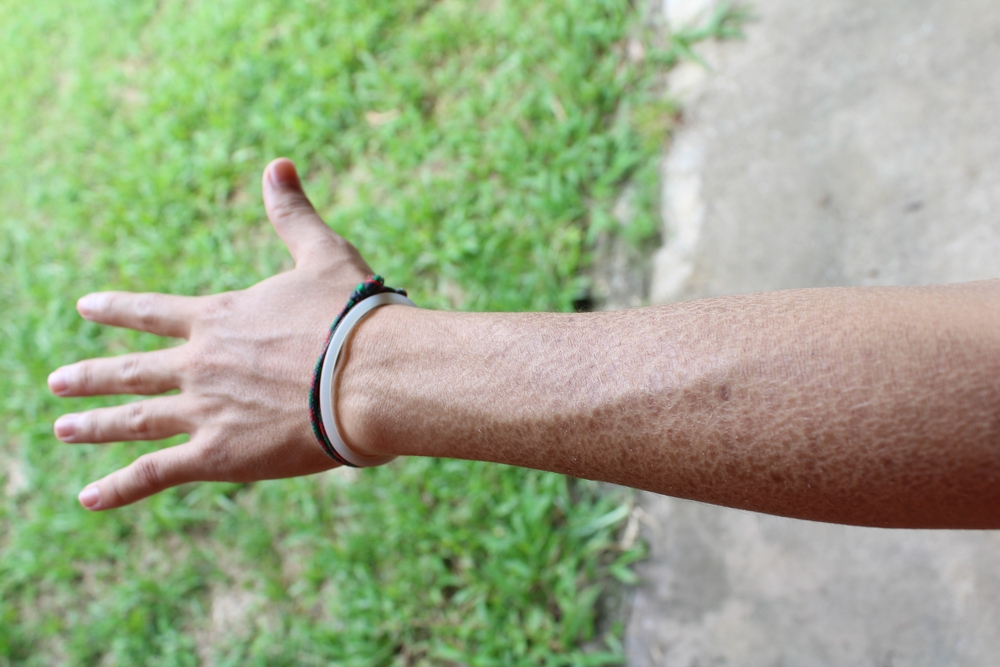
“The difference is that it's genetic, so the skin doesn't shed properly and dead skin cells build up, giving that rough, flaky, scale-like appearance particularly over the shins, arms and trunk, that no amount of moisturiser seems to completely fix.”
“It is caused by variants in a gene called filaggrin (FLG),” adds consultant dermatologist Professor Edel O'Toole. “Loss of filaggrin causes a reduction in natural moisturising factor, which is necessary to absorb water into the skin and keep the skin hydrated.”
The difference between Ichthyosis Vulgaris and dry skin is that dry skin usually improves with the weather, consistent moisturising or by switching up your routine.
“Ichthyosis tends to have a much longer history. Patients often say they've "always had it," and it sometimes runs in families. says Dr Fabusiwa.
“In standard dry skin, there are fine, dull-looking scales,” adds Prof O'Toole. “Ichthyosis scales are geometric, often white, grey or brown that curl at the edges. Dry skin is generalised, whereas ichthyosis scales are more prominent on extensor surfaces.”
Treatments to avoid in patients with ichthyosis vulgaris
Dr Fabusiwa urges that the biggest thing to remember when it comes to Ichthyosis vulgaris is that the skin barrier is already struggling… “So this isn't skin that needs to be pushed harder. I'd be much more cautious with aggressive peels, frequent exfoliation or treatments that create unnecessary inflammation,” she says.
“Often the best results come from calming and hydrating the skin first rather than trying to chase perfectly smooth skin.”
Myths associated with ichthyosis vulgaris
“Some individuals may be concerned that ichthyosis vulgaris is infectious or caused by lack of hygiene rather than a genetic skin disorder that affects how the skin sheds,” says Prof O'Toole.
Understanding the condition can help patients navigate a lifetime of suffering...
“Some aesthetic practitioners may think that aggressive physical abrasion may help, but the skin in ichthyosis vulgaris is actually quite delicate with a compromised barrier,” adds O’Toole.
“Most people with ichthyosis have tried every cream on the shelf before they've walked into your clinic, so telling patients to moisturise more isn’t helpful,” says Dr Fabusiwa. “The goal isn't to cure it, because we can't, but to improve comfort, texture and reduce flares with realistic expectations.”
Impact on mental health
Ichthyosis vulgaris isn't "just dry skin".
“If your skin is constantly flaky, rough or visibly different, it can affect confidence, clothing choices, relationships and even simple things like wanting to wear shorts in the summer. Acknowledging that goes a long way,” explains Dr Fabusiwa.
“95% of patients with ichthyosis generally have reduced quality of life, and one third have anxiety or depression,” says Prof O'Toole.
“Patients can have treatment fatigue from having to apply lots of creams daily to manage their skin. Individuals with ichthyosis may be bullied and/or experience discrimination due to their physical appearance. Itching can disrupt sleep patterns and cause chronic fatigue. The visible nature and chronicity of the condition may restrict relationships, academic achievements and career aspirations. This is exacerbated by the presence of eczema, continues Prof O'Toole.
Co-morbid conditions
Eczema, unfortunately, very often co-occurs with ichthyosis vulgaris.
“There's a huge overlap,” says Dr Fabusiwa. “Many patients with ichthyosis also have eczema or other atopic conditions, so it's not unusual for them to fluctuate between being dry, flaky and inflamed.”
Prof O'Toole explains that variants in the FLG gene are the best-known genetic risk association with atopic eczema.
“Up to 50% of patients with ichthyosis vulgaris also have eczema,” says Prof O’Toole. “Their skin may be more troublesome with itching and redness during flares and prone to infection.”
“They will likely be using topical steroids to treat their eczema in addition to emollients. Some of the creams used for ichthyosis may be irritating to their eczema so a gentler approach may be required,” she adds.
“That's why I'd always tailor treatment to how the skin looks on the day rather than following a one-size-fits-all plan,” adds Dr Fabusiwa.
Which ingredients help patients with ichthyosis vulgaris?
“I'm a big fan of the boring ingredients here because they work,” Dr Fabusiwa continues. “Urea is excellent for softening thickened skin while also drawing in water. Lactic acid and salicylic acid can help reduce scaling, but they need introducing gradually, especially if there's eczema alongside it. Rich moisturisers are equally important because without repairing the barrier, patients often end up stuck in a cycle of irritation.”
Ceramides should be a top recommendation for patients suffering from ichthyosis vulgaris.
“Creams containing ceramides repair the impaired skin barrier by physically replacing the intercellular lipid that binds skin cells together,” says Prof O’Toole. “In normal skin, ceramides make up about 50% of the skin barrier lipids.
Our experts say that ultimately, practitioners should tailor recommendations according to patient choice.
“Usually a trial of several creams is required to work out the best long-term solution. The best cream is the cream that works and that the patient will use regularly,” adds O’Toole.
O’Toole also sometimes recommends a few handfuls of bicarbonate of soda in a warm bath followed by gentle mechanical assistance with a loofah, for example, which may help with exfoliation.
Emerging therapies for ichthyosis vulgaris
Interestingly, there are a few emerging therapies that could change the landscape for patients suffering from ichthyosis vulgaris in the future.
A company called Azitra is developing engineered strains of Staphylococcus epidermidis (a skin colonising bug) as live biotherapeutic products to treat serious skin diseases and dermatologic conditions. Strain ATR-01 is being engineered to secrete human filaggrin to target ichthyosis vulgaris.
Preclinical data has already shown improved skin barrier function, with human clinical trials planned in the future.
Emerging evidence is also connecting Th2 cytokines to filaggrin suppression. “Doctors are exploring the repurposing of biologic therapies that target IL-4 and IL-13 pathways (commonly used for severe eczema, e.g., dupilumab) to help naturally restore the skin barrier,” says O’Toole.
Practical advice for practitioners
When presented with ichthyosis vulgaris in clinic, Dr Fabusiwa says: “Respect the barrier. Go slowly. Don't overpromise.”
Adding that, sometimes the most valuable thing you can do is explain what's actually happening to your patient’s skin and reassure them they're not failing because a standard body lotion hasn't worked.
"Good skincare can make a huge difference, but it's about long-term management rather than a quick fix.”
Dr O’Toole reminds us of the importance of mental health support for managing skin conditions… “Advice on how to manage the stress associated and how best to apply creams is also hugely important. Support from patient groups such as the Ichthyosis Support Group is also critical.”