A new, profession-led body, the British College of Cosmetic Surgery, has launched with the goal of setting a recognised national benchmark for excellence in cosmetic surgery practice.
During an era when demand for cosmetic procedures is at an all time high, the College is set to introduce a rigorous new Fellowship pathway designed to ensure surgeons can demonstrate measurable competence, transparency and accountability, regardless of their primary specialty background.
The Founding board includes Dr Ashish Dutta, Dr Ian Morgan, Dr Alexandra Chambers, Dr Marboor Bhatty and Dr Sayani Sainudeen. Together, the founding board brings extensive expertise across plastic surgery, aesthetic surgery and surgical education, united by a shared goal of strengthening professional standards within cosmetic surgery.
“Cosmetic surgery continues to evolve rapidly, and with that evolution must come clear, measurable standards,” says Dr Sayani Sainudeen, Co-Founder and Board Member of the British College of Cosmetic Surgery.
“Our aim is to provide patients with confidence and surgeons with a framework that reflects true excellence. This Fellowship is about accountability, transparency and raising the bar for our entire specialty across the UK.”
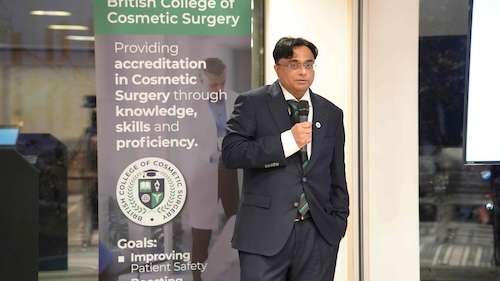
Dr Sayani Sainudeen
About the Fellowship pathway
The Fellowship is open to UK surgeons including plastic surgeons, general surgeons, breast surgeons and doctors practising cosmetic surgery aiming to provide a structured pathway for surgeons who may not be on the GMC specialist register in plastic surgery to demonstrate competency through independent assessment.
“While there is already a voluntary certification scheme run via the Royal Colleges, the British College of Cosmetic Surgery provides a dedicated body focused exclusively on cosmetic surgery standards across specialties, with the ambition of becoming the recognised benchmark for excellence across the UK,” said the new College in a statement.
The pathway includes:
Structured Educational Programme
Candidates undertake directed reading and attend lectures at the Royal Society of Medicine (RSM), ensuring strong academic and theoretical foundations.
Part 1 – MSQ Examination
Surgeons must pass a Multiple Structured Question (MSQ) examination to demonstrate knowledge and understanding of cosmetic surgical principles, safety and ethics.
Logbook and Case Evidence
Applicants are required to submit documented evidence of a specified number of cosmetic surgery cases, demonstrating breadth of experience, outcomes and safe practice.
Part 2 – Clinical Practice Assessment
An examiner - drawn from leading cosmetic surgeons in their field - visits the candidate’s practice to observe live surgery, review clinical governance processes and assess patient follow-up care.
Oral Examination (Viva)
A final oral examination assesses clinical judgement, complication management, ethical practice and decision-making.
Successful candidates are awarded Fellowship status and formal accreditation by the College.
You may also like to read: From filters to facelifts: the new patient profile
.JPG)